
RRB NTPC Syllabus 2026 For Graduate – CBT 1 & CBT 2

Share:

The Railway Recruitment Boards (RRBs), Ministry of Railways, Government of India have published the comprehensive examination scheme and detailed syllabus for the RRB NTPC (Graduate) Examination 2026 under Centralised Employment Notification (CEN) No. 06/2026. Candidates preparing for 3,477 tentative vacancies across 7th CPC Pay Level-5 and Pay Level-6 posts must thoroughly understand the staged selection process, which includes 1st Stage CBT (Screening), 2nd Stage CBT (Level-Wise), Computer Based Aptitude Test (CBAT) for Traffic Assistant/Station Master, and Typing Skill Test (TST) for designated typist posts.

According to the official RRB NTPC syllabus notification, both CBT 1 and CBT 2 evaluate candidates across three major subjects: Mathematics, General Intelligence & Reasoning, and General Awareness. A negative marking penalty of 1/3rd mark applies for every incorrect response in both CBT stages. Below is the complete section-wise syllabus, examination pattern, minimum qualifying marks, CBAT score criteria, typing standards, and preparation tips directly derived from the official Railway recruitment documents.

Important RRB NTPC Syllabus Notification Highlights: The 1st Stage CBT is common for all notified graduate posts and serves as a screening test with normalized marks. The 2nd Stage CBT is administered separately for Pay Level-5 and Level-6 with graded difficulty. Candidates qualifying for Station Master and Traffic Assistant posts must secure a minimum T-Score of 42 in each CBAT test battery (where 70% CBT-2 + 30% CBAT weightage determines final merit). The Typing Skill Test is strictly qualifying with 30 WPM (English) or 25 WPM (Hindi).

Railway Recruitment Boards (RRBs) – Ministry of Railways

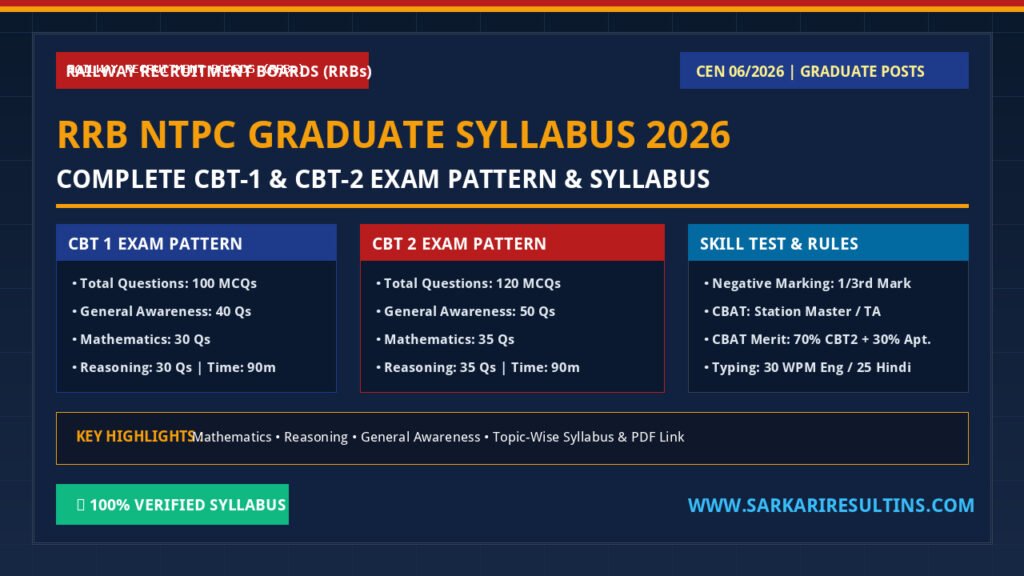
RRB NTPC Graduate Syllabus 2026 : CBT 1 & CBT 2 Exam Pattern

Centralised Employment Notification (CEN) No. 06/2026 (Graduate Posts) : Scheme of Examination

WWW.SARKARIRESULTINS.COM

Important Examination Dates & Timeline

  • Indicative Notice Released : 26/09/2026
  • Online Application Begin : 08/10/2026 (Tentative)
  • Last Date for Apply Online : 06/11/2026 (11:59 PM)
  • Detailed CEN Notification : To Be Released Soon
  • CBT-1 Exam City Intimation Slip : ~10 Days Before Exam
  • CBT-1 Admit Card / Hall Ticket : 4 Days Before Exam
  • 1st Stage CBT Exam Date : To Be Notified Soon
  • 2nd Stage CBT Exam Date : To Be Notified Later
  • CBAT & Typing Skill Test Date : After CBT-2 Result

Dates and timelines are structured as per official Railway recruitment guidelines.

Exam Scheme & Key Norms

  • Mode of Examination : Computer Based Test (Online)
  • Question Format : Multiple Choice Questions (MCQs)
  • CBT 1 Total Marks / Questions : 100 Questions (100 Marks)
  • CBT 2 Total Marks / Questions : 120 Questions (120 Marks)
  • Negative Marking : 1/3 Mark Deducted per Wrong Answer
  • Exam Duration : 90 Minutes (120 Mins for PwBD w/ Scribe)
  • CBT 1 Role : Screening Nature (Normalized Score)
  • Languages Available : English, Hindi & 13 Regional Languages
  • Final Merit Base : CBT-2 Normalized Marks (+ CBAT for SM/TA)

No negative marking applies in the Computer Based Aptitude Test (CBAT).

RRB NTPC Graduate Syllabus 2026 – Short Details

Details Information
Exam Name RRB NTPC Graduate Examination 2026
Conducting Body Railway Recruitment Boards (RRBs), Ministry of Railways
Recruitment Category Non-Technical Popular Categories (Graduate Level) – CEN No. 06/2026
Notified Tentative Vacancies 3,477 Posts (Pay Level-5 and Pay Level-6)
Selection Stages CBT 1 → CBT 2 → CBAT / Typing Skill Test (as applicable) → DV → Medical Exam
CBT 1 Structure 100 MCQs | 100 Marks | Screening Test (Normalized Score used for shortlisting)
CBT 2 Structure 120 MCQs | 120 Marks | Post/Pay Level-Wise Test (Decides final selection merit)
CBAT Applicability For Traffic Assistant & Station Master Posts (Min. T-Score 42 in each battery)
Typing Skill Test For Applicable Typist Posts (Qualifying only – 30 WPM English / 25 WPM Hindi)
Negative Marking 1/3 Mark for Each Wrong Answer in CBT 1 & CBT 2
Official Application Website www.rrbapply.gov.in

RRB NTPC CBT 1 Exam Pattern 2026 (1st Stage Computer Based Test)

The 1st Stage Computer Based Test (CBT 1) is a common screening test for all graduate-level posts notified under CEN No. 06/2026. The examination evaluates candidates over 100 objective multiple-choice questions for 100 marks. Marks scored in CBT 1 are normalized to shortlist candidates for the 2nd Stage CBT at a ratio of approximately 1:15 of the community-wise vacancies.

Subject / Section Number of Questions Maximum Marks
General Awareness 40 Questions 40 Marks
Mathematics 30 Questions 30 Marks
General Intelligence & Reasoning 30 Questions 30 Marks
Total 100 Questions 100 Marks
Candidate Category Exam Duration
Normal Candidates (All eligible non-scribe candidates) 90 Minutes (1 Hour 30 Minutes)
Eligible PwBD Candidates with Scribe Assistance 120 Minutes (2 Hours)

Note: Negative marking of 1/3rd mark applies for every wrong answer. The section-wise question distribution is indicative and subject to slight variations in actual question papers.

RRB NTPC CBT 1 Syllabus 2026 – Detailed Subject-Wise Topics

1. Mathematics (30 Questions / 30 Marks)

The Mathematics section tests conceptual understanding, numerical proficiency, calculation speed, and fundamental mathematical problem-solving skills:

  • Number System (Integers, Real Numbers, Divisibility Rules)
  • Decimals & Fractions (Conversion, Comparison, Operations)
  • LCM & HCF (Lowest Common Multiple and Highest Common Factor)
  • Ratio and Proportions (Direct & Inverse Proportions, Mean Proportion)
  • Percentage (Calculation, Increase/Decrease, Application)
  • Mensuration (Perimeter, Area, Volume of 2D and 3D Geometric Shapes)
  • Time and Work (Work Efficiency, Pipes and Cisterns)
  • Time and Distance (Speed, Trains, Boats & Streams, Relative Speed)
  • Simple Interest & Compound Interest (Annual/Compounded Periodically)
  • Profit and Loss (Cost Price, Selling Price, Marked Price, Discount, Margin)
  • Elementary Algebra (Linear Equations, Algebraic Identities, Polynomials)
  • Geometry (Lines, Angles, Triangles, Quadrilaterals, Circles, Theorems)
  • Trigonometry (Trigonometric Ratios, Standard Angles, Identities, Heights & Distances)
  • Elementary Statistics (Mean, Median, Mode, Standard Deviation, Data Representation)

2. General Intelligence & Reasoning (30 Questions / 30 Marks)

The Reasoning section examines analytical logic, critical thinking, visual and verbal pattern identification, and deduction capabilities:

  • Analogies (Semantic, Number, Symbolic and Letter Analogies)
  • Completion of Number Series & Alphabetical Series
  • Coding and Decoding (Letter Coding, Number Coding, Substitution)
  • Mathematical Operations (Interchange of signs and numbers, BODMAS rules)
  • Similarities and Differences (Classification / Odd One Out)
  • Relationships (Blood Relations, Family Tree Problems)
  • Analytical Reasoning (Logical deductions, arrangement patterns)
  • Syllogism (Statement-based deductive logic, Venn method)
  • Jumbling (Sentence / Word / Number re-arrangement)
  • Venn Diagrams (Set theory representations, overlapping categories)
  • Puzzles (Seating arrangement, linear/circular tables, floor puzzles)
  • Data Sufficiency (Sufficiency of statements to answer problems)
  • Statement & Conclusion (Drawing logical deductions)
  • Statement & Courses of Action (Decision under given scenarios)
  • Decision Making (Eligibility criteria matching and case studies)
  • Maps & Spatial Orientation (Direction sense test, map reading)
  • Interpretation of Graphs (Bar charts, pie charts, line graphs, data tables)

3. General Awareness (40 Questions / 40 Marks)

General Awareness carries the highest weightage (40% of CBT 1) and evaluates national and global awareness across contemporary events, science, history, geography, and governance:

  • Current Events: National and International Importance (Summits, Awards, Appointments, Treaties)
  • Games and Sports: Olympics, Asian Games, World Cups, Famous Athletes, Rules, Trophies
  • Art and Culture of India: Classical Dances, Folk Arts, Festivals, Music, Painting Traditions
  • Indian Literature: Famous Authors, Literary Awards (Jnanpith, Sahitya Akademi), Books
  • Monuments and Places of India: Heritage Sites, UNESCO World Heritage, Architectural Marvels
  • General Science & Life Science: Physics, Chemistry, Biology up to 10th CBSE curriculum
  • History of India: Ancient, Medieval, and Modern Indian History
  • Indian Freedom Struggle: 1857 Revolt, Gandhian Era, Revolutionary Movements, Independence
  • Physical, Social and Economic Geography: India & World Geography (Rivers, Mountains, Climate, Resources, Demographics)
  • Indian Polity and Governance: Constitution of India, Preamble, Fundamental Rights, Duties, Amendments
  • Political System: Parliament, Judiciary, President, Governor, Panchayati Raj, Federal Structure
  • General Scientific & Technological Developments: Innovations, Defence Tech, Emerging Tech
  • Space Programme of India: ISRO Missions (Chandrayaan, Gaganyaan, Aditya, Satellite launches)
  • Nuclear Programme of India: Atomic Energy Commission, Nuclear Power Plants, Peaceful Uses
  • United Nations & Important World Organizations: UN Bodies, WHO, WTO, IMF, World Bank, BRICS, G20
  • Environmental Issues: Climate Change, Global Warming, Biodiversity Conservation, Treaties (COP)
  • Basics of Computers & Applications: Hardware, Software, Internet, Operating Systems, Networking
  • Common Abbreviations & Acronyms: IT, Science, Government, Economic Terms
  • Transport Systems in India: Indian Railways Network, Vande Bharat, National Highways, Ports, Aviation
  • Indian Economy: Economic Planning, Budget, GDP, Inflation, Banking System (RBI), Taxes (GST)
  • Famous Personalities: National and International leaders, scientists, reformers, pioneers
  • Flagship Government Programmes: Pradhan Mantri schemes, social welfare programs, youth & education missions
  • Flora and Fauna of India: Wildlife Sanctuaries, National Parks, Biosphere Reserves, Endangered Species
  • Important Government & Public Sector Organizations: Maharatna, Navratna, DRDO, CSIR, BHEL, NTPC, ONGC

RRB NTPC CBT 2 Exam Pattern 2026 (2nd Stage Computer Based Test)

The 2nd Stage Computer Based Test (CBT 2) is administered separately for each 7th CPC Pay Level (Level-5 and Level-6). Candidates shortlisted on the basis of CBT 1 normalized merit will appear in CBT 2. CBT 2 features a higher number of questions (120 questions for 120 marks) with a higher difficulty gradient, and the normalized marks scored in CBT 2 directly dictate the final selection merit list.

Subject / Test Section Number of Questions Maximum Marks
General Awareness 50 Questions 50 Marks
Mathematics 35 Questions 35 Marks
General Intelligence & Reasoning 35 Questions 35 Marks
Total 120 Questions 120 Marks
Candidate Category Exam Duration
Normal Candidates (All eligible non-scribe candidates) 90 Minutes (1 Hour 30 Minutes)
Eligible PwBD Candidates with Scribe Assistance 120 Minutes (2 Hours)

Note: There is a negative marking of 1/3rd mark for each wrong answer in CBT 2. Candidates must manage time strictly as 120 questions must be attempted within 90 minutes.

RRB NTPC CBT 2 Syllabus 2026 – Advanced Subject-Wise Topics

The CBT 2 syllabus covers the same broad three subjects as CBT 1, but questions feature deeper analytical rigor, multi-step problem solving, and higher difficulty tailored to graduate cadre responsibilities across Pay Level-5 and Level-6:

A. Mathematics Syllabus for CBT 2 (35 Questions)

  • Number & Arithmetic: Number System, Decimals, Fractions, LCM & HCF, Ratio and Proportion, Percentage, Profit and Loss, Simple & Compound Interest, Time and Work, Time and Distance.
  • Algebra: Elementary Algebra, Linear & Quadratic equations, Polynomial factorization, Algebraic identities.
  • Geometry & Trigonometry: Geometric properties of triangles, circles, polygons, Heights and Distances, Trigonometric identities.
  • Mensuration & Statistics: Surface areas and volumes of composite solids, Mean, Median, Mode, Standard Deviation, Histograms and Frequency Polygons.

B. General Intelligence & Reasoning Syllabus for CBT 2 (35 Questions)

  • Logical & Analytical: Analogies, Number and Alphabetical Series, Coding-Decoding, Mathematical Operations, Similarities and Differences, Complex Relationships.
  • Deductive & Critical: Syllogisms, Jumbling, Venn Diagrams, Multi-variable Puzzles, Seating Arrangements, Data Sufficiency.
  • Judgment & Interpretation: Statement-Conclusion, Statement-Courses of Action, Decision Making, Map interpretation, Graph and Chart Analysis.

C. General Awareness Syllabus for CBT 2 (50 Questions)

  • Current Affairs: Comprehensive National and International Events, Government Schemes, Summits, Treaties, Sports.
  • Heritage, Science & Culture: Indian Art & Culture, Literature, Monuments, Life Science & General Science up to 10th CBSE standard.
  • History & Geography: Indian History, Freedom Struggle, Physical, Social and Economic Geography of India & World.
  • Polity & Economy: Indian Polity, Constitution, Political System, Indian Economy, Banking & Financial Institutions.
  • Technology & Global Bodies: Space and Nuclear Programmes of India, UN & World Organizations, Environmental Policies, Computer Basics & Applications, Flora & Fauna, Public Sector Undertakings (PSUs).

RRB NTPC Minimum Qualifying Marks (CBT 1 & CBT 2)

To be eligible for consideration and shortlisting, candidates must secure the following minimum percentage of marks in CBT 1 and CBT 2 as laid down in the official RRB NTPC syllabus notification:

Category / Community Minimum Qualifying Percentage
Unreserved (UR) 40%
Economically Weaker Section (EWS) 40%
Other Backward Classes (OBC – Non-Creamy Layer) 30%
Scheduled Caste (SC) 30%
Scheduled Tribe (ST) 25%

PwBD Reservation Rule: The qualifying percentage may be relaxed by 2% for PwBD candidates in case of shortage of eligible PwBD candidates against reserved vacancies.

RRB NTPC Computer Based Aptitude Test (CBAT) 2026

The Computer Based Aptitude Test (CBAT) is exclusively applicable to candidates who have opted for the posts of Traffic Assistant and Station Master. Shortlisting for CBAT is done at 8 times the number of vacancies based on CBT 2 normalized marks.

Parameter / Condition CBAT Rule & Guidelines
Applicable Posts Traffic Assistant (Level-4) & Station Master (Level-6)
Qualifying Standard Must secure a minimum T-Score of 42 marks in each test battery to qualify (No category relaxation).
Negative Marking NO Negative Marking in CBAT
Merit Composition 70% Weightage for 2nd Stage CBT + 30% Weightage for CBAT
Compulsory Vision Certificate Candidates shortlisted for CBAT must produce the prescribed Vision Certificate in original (Medical Standard A-2) issued by an eye specialist at the time of CBAT entry.

RRB NTPC Typing Skill Test 2026 (For Typist Posts)

The Typing Skill Test is applicable to candidates applying for clerical and accounts posts requiring typing proficiency. The test is strictly qualifying in nature; marks obtained are not added to the final merit list.

Particular Details & Specifications
Applicable Typist Posts Senior Clerk cum Typist, Junior Accounts Assistant cum Typist, Senior Time Keeper, Junior Clerk cum Typist, Accounts Clerk cum Typist, Junior Time Keeper
English Typing Speed Minimum 30 Words Per Minute (WPM)
Hindi Typing Speed Minimum 25 Words Per Minute (WPM)
Hindi Fonts Available Kruti Dev and Mangal fonts provided on computer systems
Testing Conditions Conducted on Personal Computer (PC) without editing tools, auto-correct or spell-check facilities
Exemption for PwBD Eligible PwBD candidates permanently disabled from typing are exempted upon submitting a medical certificate from an authorized medical board.

RRB NTPC Graduate Selection Process 2026

Based on the applied post and departmental cadre, recruitment proceeds through the following sequential stages:

Step 1: 1st Stage Computer Based Test (CBT-1) → Common screening examination (100 Marks, 90 Mins) for all candidates.
Step 2: 2nd Stage Computer Based Test (CBT-2) → Level-wise examination (120 Marks, 90 Mins) for shortlisted candidates (~1:15 ratio).
Step 3: Skill Test Stage (As Applicable):
• For Station Master & Traffic Assistant: Computer Based Aptitude Test (CBAT) – 30% merit contribution.
• For Typist Posts: Typing Skill Test (TST) – Qualifying nature only.
• For Non-Typist / Non-CBAT Posts: Direct shortlisting based on normalized CBT-2 performance.
Step 4: Document Verification (DV) → Verification of educational certificates, community certificates, and identities equal to vacancy numbers.
Step 5: Medical Examination (ME) → Strict medical fitness test conducted by Railway Medical Authorities as per post-specific standards (e.g., A-2, B-2, C-2).
Step 6: Final Emplacement & Appointment → Allotment of division and cadre based on merit-cum-preference.

RRB NTPC Syllabus 2026 Preparation Tips & Strategy

Mathematics: Master arithmetic topics first (Number System, Percentages, Ratio, Profit & Loss, Time & Work, SI/CI) to secure quick marks. Dedicate daily practice to Elementary Algebra, Geometry theorems, and Trigonometric ratios. Memorize squares up to 40, cubes up to 25, and fraction-to-percentage tables for quick calculation.

Reasoning: Practice analytical and logical puzzles daily. Focus on Coding-Decoding, Syllogisms, Venn Diagrams, and Data Sufficiency. Work extensively on Statement-Conclusion questions since RRB NTPC tests critical decision making.

General Awareness: Revise 10th-grade CBSE Science (Physics, Chemistry, Life Science) thoroughly. Maintain revision notes of the last 12 months of current events, Indian Freedom Struggle, Constitution & Polity, and Indian Railways milestones & schemes.

CBT 2 Speed & Accuracy: Because CBT 2 contains 120 questions in 90 minutes, speed is paramount (less than 45 seconds per question). Take regular full-length mock tests to minimize negative marking penalties.

Typing & CBAT: If targeting Station Master, practice psychometric mock test batteries. For typist roles, practice typing on a physical keyboard daily aiming for 35+ WPM (English) or 30+ WPM (Hindi) to comfortably surpass cutoff limits on exam day.

RRB NTPC Syllabus 2026 – Important Highlights Checklist

  • CBT 1 contains 100 questions for 100 marks (Duration: 90 Minutes).
  • CBT 2 contains 120 questions for 120 marks (Duration: 90 Minutes).
  • Both CBT 1 and CBT 2 have 1/3 negative marking for every incorrect answer.
  • CBT 1 subject split: 40 GA, 30 Mathematics, 30 Reasoning.
  • CBT 2 subject split: 50 GA, 35 Mathematics, 35 Reasoning.
  • CBT 1 is screening in nature; normalized scores decide eligibility for CBT 2.
  • CBT 2 normalized marks determine the primary merit for document verification.
  • CBAT applies only to Traffic Assistant and Station Master posts (Minimum T-Score 42 in each battery).
  • CBAT has no negative marking; final merit weightage is 70% (CBT 2) + 30% (CBAT).
  • Typing Skill Test is qualifying only (30 WPM English / 25 WPM Hindi in Kruti Dev/Mangal fonts).
  • Minimum qualifying percentages: UR/EWS – 40%, OBC/SC – 30%, ST – 25% (2% relaxation for PwBD).

RRB NTPC Graduate Syllabus 2026 – Important Links

Particular Link
Download Official Syllabus & Scheme (PDF) Click Here
Download Previous Year Question Papers Click Here
Apply Online (CEN 06/2026 Graduate) Link Activate Soon (08/10/2026)
Download CEN 06/2026 Indicative Notice Click Here
Download Detailed CEN No. 06/2026 Notification Link Activate Soon
RRB Official Online Application Portal Click Here
Railway Recruitment Boards Official Website Click Here
Photo, Signature Resizer & PDF Tools Sarkari Result Tools
Join Telegram Channel Join Telegram Channel
Join WhatsApp Channel Join WhatsApp Channel

Frequently Asked Questions (FAQs) – RRB NTPC Graduate Syllabus 2026

Q.1 What subjects are covered in RRB NTPC Graduate Syllabus 2026?

The RRB NTPC Graduate syllabus covers three core subjects for both CBT 1 and CBT 2: Mathematics, General Intelligence & Reasoning, and General Awareness.

Q.2 How many questions and marks are in RRB NTPC CBT 1?

RRB NTPC CBT 1 consists of 100 questions for 100 marks: 40 questions in General Awareness, 30 questions in Mathematics, and 30 questions in General Intelligence & Reasoning. The test duration is 90 minutes (120 minutes for eligible PwBD candidates with scribe).

Q.3 How many questions are asked in RRB NTPC CBT 2?

RRB NTPC CBT 2 consists of 120 questions for 120 marks: 50 questions in General Awareness, 35 questions in Mathematics, and 35 questions in General Intelligence & Reasoning. The duration is 90 minutes.

Q.4 Is there negative marking in RRB NTPC CBT 1 and CBT 2?

Yes. A negative marking penalty of 1/3rd mark is deducted for each wrong answer in both CBT 1 and CBT 2 examinations. However, there is no negative marking in the Computer Based Aptitude Test (CBAT).

Q.5 What is the RRB NTPC Mathematics syllabus?

The Mathematics syllabus includes Number System, Decimals, Fractions, LCM, HCF, Ratio and Proportions, Percentage, Mensuration, Time and Work, Time and Distance, Simple Interest, Compound Interest, Profit and Loss, Elementary Algebra, Geometry, Trigonometry, and Elementary Statistics.

Q.6 Is CBAT compulsory for every RRB NTPC Graduate post?

No. The Computer Based Aptitude Test (CBAT) is exclusively compulsory for candidates who have applied and opted for Station Master and Traffic Assistant posts. Candidates must score a minimum T-score of 42 marks in each test battery to qualify.

Q.7 What is the required typing speed for RRB NTPC typist posts?

Candidates must achieve a minimum typing speed of 30 Words Per Minute (WPM) in English or 25 Words Per Minute (WPM) in Hindi. Hindi typing is conducted using Kruti Dev or Mangal fonts on a computer without editing tools.

Q.8 Is the Typing Skill Test added to the merit list?

No. The Typing Skill Test is purely qualifying in nature. The marks obtained in typing are not added to create the final merit ranking; selection relies on normalized CBT 2 scores.
Conclusion: The RRB NTPC Graduate Syllabus 2026 (CEN 06/2026) offers a balanced examination structure across Mathematics, General Intelligence & Reasoning, and General Awareness. Because CBT 1 functions as a screening stage while CBT 2 determines final selection rank, aspirants should focus on speed, conceptual clarity, and minimizing negative marking. Candidates targeting Station Master and Traffic Assistant roles should integrate aptitude battery drills, while those opting for clerical typist posts should ensure steady keyboard practice. Refer to the official Railway portals rrbapply.gov.in and rrb.indianrailways.gov.in for regular exam updates and schedule releases.

RRB NTPC Graduate Syllabus 2026 CBT 1 and CBT 2 Exam Pattern
sarkariresultins.com
Share:

Leave a Comment